The Economics of Exclusivity
Why Monaco Remains the Global Real Estate Benchmark
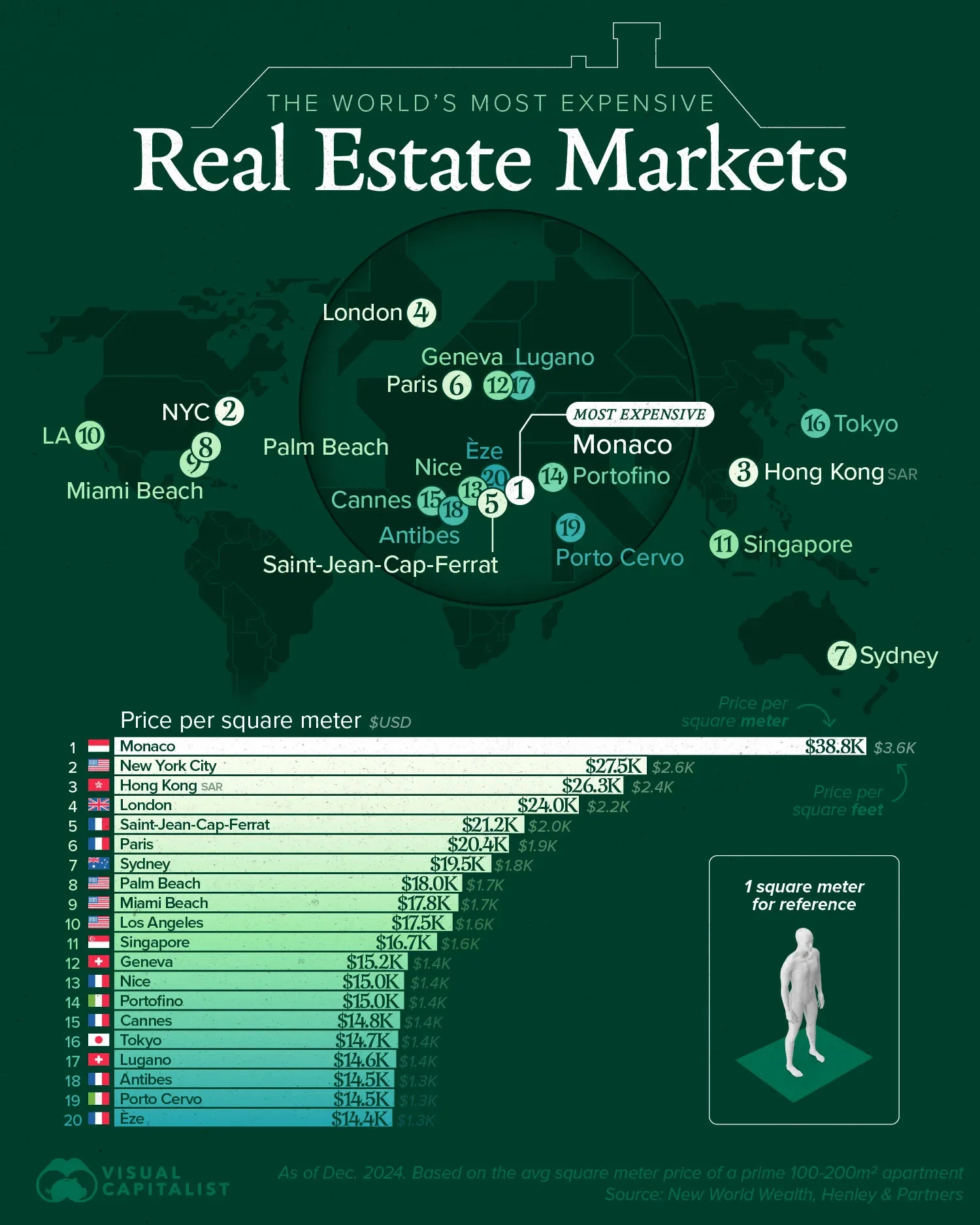
The Economics of Exclusivity: Why Monaco Remains the Global Real Estate Benchmark
For institutional investors and private wealth managers, Monaco is not merely a residential destination; it is the ultimate asset class of scarcity. As of 2026, the Principality maintains its position as the most expensive real estate market in the world, with prime capital values consistently outperforming global luxury benchmarks.
But what are the underlying economic drivers that justify these valuations?
1. The Supply-Side Constraint (The "Zero Expansion" Model)
Unlike Tier-1 cities such as London or New York, where luxury supply can be increased through high-rise development or urban expansion, Monaco is physically landlocked.
-
Geographic Fixedness: The total land area is constrained by the Mediterranean and French border.
-
Limited Turnover: New builds are rare and primarily restricted to land reclamation projects, which take years to approve and complete.
-
Supply Inelasticity: As total supply cannot scale in response to price signals, any increase in global wealth directly drives capital appreciation.
2. Institutional Resilience and Wealth Preservation
In the current macroeconomic climate, Monaco serves as a "Beta-free" investment haven. Investors prioritize capital preservation over high-yield rental income, which—while respectable—is rarely the primary driver of the investment thesis.
"In Monaco, real estate functions as a store of value. It is the real-world equivalent of a 'digital gold' strategy, designed to hedge against inflationary pressures and geopolitical volatility."
3. Fiscal and Socio-Political Arbitrage
The investment appeal is heavily underpinned by the Principality’s long-standing fiscal structure.
-
Tax Efficiency: The absence of personal income tax, capital gains tax, and property taxes for residents creates a powerful incentive for ultra-high-net-worth individuals (UHNWIs) to relocate their tax domicile.
-
Political Stability: In a year characterized by global political flux, Monaco’s institutional stability offers a "safe harbor" environment that is increasingly difficult to find elsewhere.
4. Benchmarking Against Global Prime Markets
For the discerning investor, the yield is often secondary to the security of the underlying asset. The table below highlights the divergence in investment drivers across prime global markets:
| Market | Primary Investment Driver | Volatility Profile |
| Monaco | Wealth preservation & Tax efficiency | Ultra-Low |
| Hong Kong | Gateway to Asian capital flow | Moderate |
| New York | Market liquidity & Global hub status | Moderate |
| London | Currency diversification & Prime stability | Moderate |
Strategic Outlook for 2026 and Beyond
Looking ahead, the demand-supply imbalance shows no sign of correction. As global wealth continues to concentrate, the competition for trophy assets in highly regulated, secure, and tax-efficient jurisdictions like Monaco will remain intense.
For the professional investor, the takeaway is clear: Monaco is not a speculative market driven by short-term trends; it is a structural asset play. While entry prices remain at record highs, the unique combination of legal, fiscal, and geographic scarcity ensures that the Principality will continue to command a premium that few other markets can replicate.